Dyno 2 Race - Car Tuning
- 4.6
- Rating
- 10.00M
- Installs
- Free
- Price
 Analysis by App-foxy
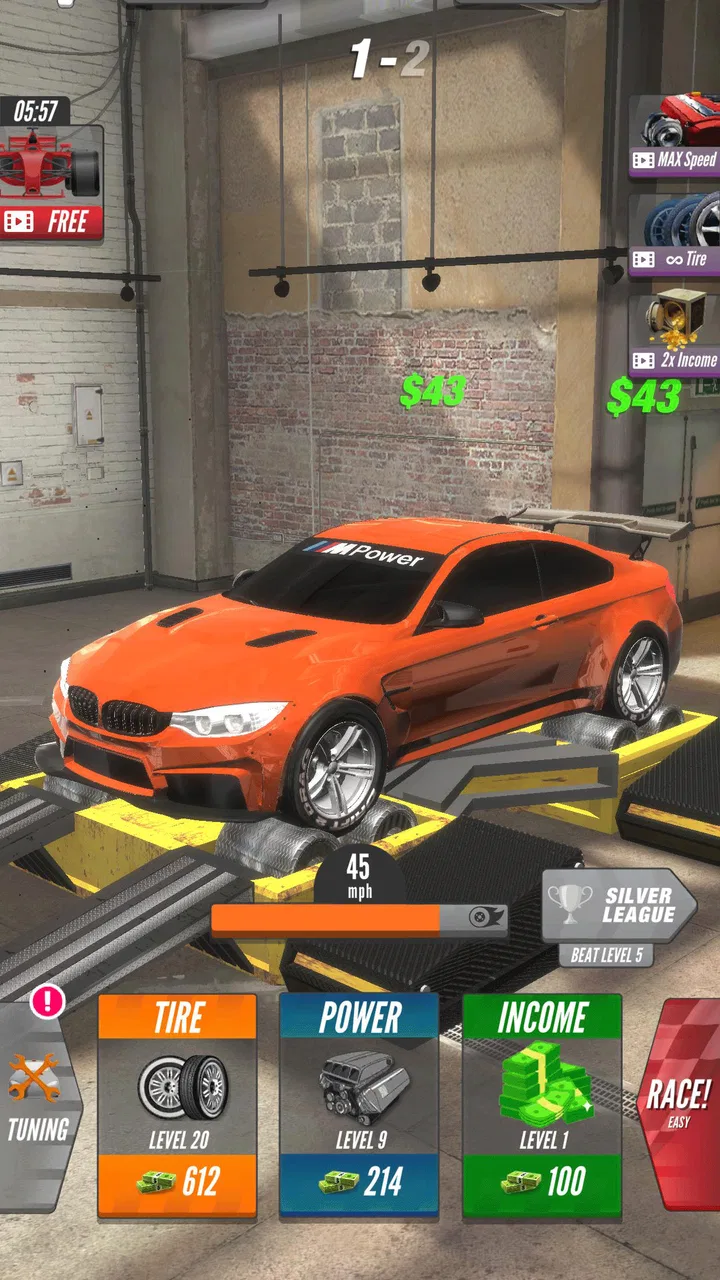
I approached Dyno 2 Race as a racing game for people who enjoy the preparation before the start as much as the actual run. Its central idea is simple: tune a car on a dyno, then take that setup into a race. That makes it feel different from a typical arcade racer where the main decision is simply when to steer or accelerate. Here, the garage work matters, and a small adjustment can change how confident I feel when I line up for the next attempt.
Developed by HyperMonk Games, the game is free to download and is rated for Everyone. It has reached over ten million installs and holds a 4.6 average from around 180 thousand ratings, which gives it a substantial audience in the mobile racing space. I can understand the appeal: it is easy to grasp in a few minutes, yet the tuning theme gives each race a little more purpose than a quick, disposable sprint.
What the dyno-first racing loop feels like
The most important thing to understand is that this is not just a car collection game with a racing screen attached. The dyno concept puts preparation at the center of the experience. I found myself thinking about the relationship between tuning and results rather than treating every loss as a reflex problem. That shift gives the game its identity.
You May Also Like

 Blood Strike: 2.5 Anniversary
Blood Strike’s Loadouts Turn Every Drop Into a Tactical Gamble
A close look at Blood Strike’s custom loadouts: how fast access to signature weapons reshapes its battle royale rhythm, rewards preparation, and narrows the gap between fights.

 Pandora - Music & Podcasts
Pandora’s Music Is Easy to Start, but Harder to Recover
Pandora’s strength is its low-effort path from a seed to a station. Its weak spot is how much confidence it asks you to place in connection, setup, and quiet recovery.

 8 Ball Pool
 Is Built on Rivalries, Rematches, and Routine
A close look at the rivalries, rematches, shared routines, and unanswered safety questions that turn a quick pool match into a persistent mobile community.

 Samsung Music
’s Quiet Strength Is Playing What You Already Own
Its reach comes less from spectacle than from dependable access to a personal library. That simplicity is both the app’s strongest retention engine and its ceiling.

 AccuWeather: Weather Radar
AccuWeather Review: A Quick, Clear Forecast for Everyday Decisions
For everyday plans, the best forecast is the one you can understand quickly. AccuWeather makes rain timing, radar, and local conditions easy to act on, with a few trade-offs.

 Hill Climb Racing
Why Hill Climb Racing Still Turns Crashes Into One More Run
A tiny car, a bumpy hill and one more upgrade: Hill Climb Racing keeps resurfacing because its simple chaos makes every near-miss feel personal.
More From Our News Desk



A normal mobile racer often rewards fast reactions, clean cornering, or learning a track. Dyno 2 Race focuses attention on the car before the race begins. The useful habit is to treat each run as a small experiment: make one meaningful change, race, and judge whether the result improved. Changing everything at once makes it harder to understand what actually helped.
That approach is especially useful for new players. Instead of trying to memorize a long list of controls, I can concentrate on a clear question: is my current setup ready for the next opponent? The answer comes from racing, not from staring at menus. This creates a satisfying connection between the workshop and the road.
Why the tuning idea works on a phone
Mobile sessions are often interrupted, so a game needs a loop that remains understandable when I return after a break. The dyno-and-race structure helps because the immediate goal is visible. I can prepare, make an attempt, and decide whether to continue or change direction. It does not demand that I remember a complicated story or a large open-world map.
One realistic use case is a short evening session. I might have only a few minutes, so I use that time to adjust the car and try a race rather than committing to a long championship-style playthrough. The game suits that pattern better than a racing title built around lengthy events, provided I am in the mood to make decisions instead of simply driving.
The trade-off is that tuning can feel slower than jumping straight into an arcade race. If I want instant action with dramatic tracks and constant visual movement, a conventional racer may be more satisfying. This game asks me to accept that the garage is part of the entertainment, not a delay before the “real” game begins.
A practical way to learn from each attempt
I recommend avoiding random adjustments. First, I identify what went wrong in the previous run: was the car difficult to control, did it feel too slow at the start, or did the setup seem unsuitable for the opponent? Then I change only the part connected to that problem. This makes the dyno feel like a tool rather than a slot machine.
Another useful habit is to keep a mental record of setups that produce reliable results. The fastest-looking configuration is not automatically the most useful if it makes the next race inconsistent. A stable setup can be more valuable when I am trying to progress without repeatedly wasting attempts. That is a less obvious strength of the game: it encourages practical tuning judgment rather than blindly chasing a single impressive result.
Players should also expect a learning curve in the language of tuning. The game is approachable, but the idea of changing a car and interpreting the result takes more attention than a pure tap-to-race title. Anyone who enjoys tinkering will probably see that as the point. Anyone who dislikes menus or mechanical experimentation may find the same structure tiring.
Progress, pressure, and the role of spending
The game is free to play, with optional in-app purchases priced from $1.99 to $13.99 per item. That is the relevant spending context I would keep in mind before installing it. I can begin without paying, but the presence of purchases means players should decide in advance whether they are comfortable treating the game as a free experience only or as something that may invite optional spending over time.
I prefer to approach this kind of racer with a fixed rule: play first, spend only if the core loop remains enjoyable without pressure, and never buy simply because a difficult race has become frustrating. The tuning system is most rewarding when I understand why a car improved. Paying to move past a problem can remove the very experimentation that makes this game distinctive.
The purchase range also matters for families. The Everyone age rating makes the game broadly accessible, but an age rating does not replace a conversation about buying. If a child uses the device, I would check the device’s purchase controls and agree on a rule beforehand. That is practical advice, not a criticism of the game; any free mobile title with optional purchases deserves that bit of preparation.
When progression feels motivating
Progress feels meaningful when a new challenge gives me a reason to revisit the dyno. A race is not merely a test of timing; it becomes feedback about the current build. I enjoy that relationship because a loss can suggest a next step instead of ending the session immediately.
There is also a psychological pressure that comes with tuning games. Once I have invested time in a setup, I may feel tempted to keep changing it even when the problem is simply that I need more practice. I have found it better to separate mechanical problems from driving mistakes. If the car feels suitable but I keep losing, more tuning may not be the answer.
This distinction saves time and reduces unnecessary spending. It also keeps the game honest as a personal challenge. I am not trying to solve every defeat with a purchase or a complete rebuild; I am trying to understand whether the issue is the car, the race, or my own decision-making.
Who should avoid the pressure entirely
I would not choose this game for someone who wants a completely frictionless racing experience. If your ideal session is selecting a car, pressing start, and enjoying immediate speed without thinking about setup, the dyno focus may feel like work. The same applies if you dislike repeating a race while refining a configuration.
I would also be cautious about recommending it to players who are easily pushed into impulse purchases. The free entry is helpful, but optional items can still create pressure when progress slows or a favorite car needs attention. The safest way to enjoy it is to treat purchases as unnecessary extras rather than as the expected route through the game.
How fair does the competition feel?
Fairness is difficult to judge from the purchase option alone. The game includes purchases ranging from $1.99 to $13.99, but that fact does not by itself prove whether paid items provide competitive advantages, speed up progress, or simply offer convenience. I would not present a stronger claim without direct, reliable evidence.
What I can say is that the tuning-centered design makes fairness especially important. When winning depends on preparing the car, players need to feel that their decisions matter. If a careful setup can compete with a paid shortcut, the system feels engaging. If spending becomes the main explanation for a result, the dyno loses some of its purpose. That is the standard I would use when evaluating the game during longer play.
For now, my recommendation is to judge the competition through your own experience rather than assuming either extreme. Try the free path, compare how much progress comes from learning the tuning loop, and pay attention to whether a purchase feels like a choice or a requirement. That is more useful than labeling the entire game fair or unfair based only on the existence of in-app purchases.
Why this is different from a standard arcade racer
In a conventional arcade racer, the main advantage usually comes from steering lines, braking points, boosts, and reaction speed. Dyno 2 Race places more weight on preparation. That makes it a better fit for someone who likes adjusting a machine and testing the result than for someone who wants a pure driving challenge.
The comparison also reveals the game’s strongest competitive quality: it gives me a reason to think before racing. I am not only asking whether I drove well; I am asking whether I gave myself the right car for the situation. That extra layer can make victories feel earned in a different way.
It is not automatically better than other racing games. A track-focused racer may provide more satisfying cornering, while an arcade title may offer more immediate spectacle. This one is preferable when the tuning decision is what keeps you interested. If the garage is something you normally skip, another racing game will probably respect your time better.
Small decisions that improve the experience
My first tip is to avoid changing the setup immediately after every loss. A single result can be misleading, especially when your own execution was inconsistent. I would give myself a clear reason for each adjustment and then test whether that reason was addressed.
My second tip is to use the dyno as a comparison tool, not just a place to chase maximum output. A setup that looks impressive in isolation may not be the easiest one to use in a race. I value repeatable behavior because it makes it easier to learn from the road and to tell whether I am improving.
My third tip is to decide on a spending boundary before the game becomes difficult. This is particularly important because the game is free to start and includes optional items. A pre-set limit protects the fun part of the experiment: I can still learn the system without turning every setback into a financial decision.
What I would want to know before installing
The minimum operating requirement is Android 7.0, so owners of older Android devices should check compatibility before expecting to play. The current version is 1.9.1, and the game was released on May 12, 2023. Those details are useful when deciding whether an older phone or tablet is likely to be a sensible place to try it.
The game’s audience size suggests that it is not an obscure experiment. It has more than ten million installs, and its average rating is 4.6 from roughly 180 thousand ratings, with about one thousand written reviews. I would treat those figures as a sign of broad interest, not as a guarantee that the tuning style will match every player.
The Everyone rating also makes it easier to recommend as a general racing game, but the actual fit still depends on temperament. A young player may enjoy the car theme, while a more experienced racing fan may appreciate the setup decisions. At the same time, people who want realistic motorsport simulation should keep their expectations measured: the appeal here is the mobile tuning loop, not a promise of a full simulation cockpit.
Another question is whether it works well for short sessions. In my experience of the game’s structure, it makes sense for brief play because the basic cycle is easy to divide into preparation and a race attempt. The more important question is whether you enjoy returning to the same problem and refining it. If you do, short sessions can feel productive. If you need constant new scenery, repetition may become noticeable.
Players may also wonder whether they need to spend money to understand the game. You can start for free, and purchases are optional, but I would not assume that every competitive or progression outcome is identical for paying and non-paying players. The responsible approach is to begin without spending, learn the tuning system, and decide whether the free experience feels worthwhile on its own.
My trust verdict after weighing the trade-offs
The best reason to try this game is the connection between tuning and racing. It gives preparation a real role and offers a more thoughtful alternative to racers that are built entirely around immediate action. I like that a failed run can lead to analysis, not just another attempt with the same car and the same habits.
My reservations are equally clear. The game may feel slow to players who want instant races, and the presence of optional purchases means I would use sensible spending controls. I also would not make a definitive claim about competitive fairness without knowing exactly how paid items affect progression or performance. That uncertainty is a reason to observe your own experience carefully, not a reason to assume the worst.
For a friend who enjoys car setup, gradual improvement, and testing one decision at a time, I would recommend giving it a free trial. I would suggest starting with a no-spending rule, learning how the dyno changes the race, and deciding after several sessions whether the experimentation remains enjoyable. For someone seeking pure arcade speed, deep track simulation, or a guaranteed pressure-free progression path, I would point toward a different racing style.
Overall, HyperMonk Games has built a racing game with a specific personality rather than another generic driving loop. Its free entry, broad age rating, and large player base make it easy to explore, while its real value depends on whether you enjoy the work before the finish line. I would keep it installed for tuning-focused sessions, but I would approach its purchases thoughtfully and let the quality of the free experience decide whether it deserves more of my time.
FAQs for Dyno 2 Race - Car Tuning
01What is Dyno 2 Race - Car Tuning about?
Dyno 2 Race - Car Tuning is a mobile game that allows players to customize and tune their cars for racing competitions. Offering a variety of vehicles and tuning options, the game focuses on realistic physics and performance enhancements, providing an immersive experience for car enthusiasts and gamers alike.
02Is Dyno 2 Race - Car Tuning free to play?
Yes, Dyno 2 Race - Car Tuning is free to download and play on both Android and iOS platforms. However, the game includes in-app purchases that offer additional features, enhancements, and customization options. These purchases are optional and are aimed at enhancing the gaming experience.
03What are the main features of Dyno 2 Race - Car Tuning?
The game features a wide range of customizable cars, realistic tuning options, and detailed graphics. Players can adjust various aspects of their vehicles, including engine performance, aerodynamics, and styling. The game also includes competitive racing modes and challenges to test players' tuning skills against others.
04Are there any specific system requirements to play Dyno 2 Race - Car Tuning?
Dyno 2 Race - Car Tuning requires a device running Android 5.0 or iOS 10.0 and above. For optimal performance, it is recommended to play on devices with at least 2GB of RAM. This ensures smooth gameplay and allows players to fully enjoy the detailed graphics and intricate tuning features.
05How does the multiplayer feature work in Dyno 2 Race - Car Tuning?
The multiplayer feature in Dyno 2 Race - Car Tuning allows players to compete with friends or other gamers worldwide. Players can join races, participate in tournaments, and compare their custom builds. The game includes leaderboards and ranking systems to track performance and progress in the competitive racing community.
Pros
- Extensive car customization options.
- Realistic racing physics enhance gameplay.
- Wide variety of tracks to explore.
- Regular updates with new content.
- Multiplayer mode for competitive play.
Cons
- In-app purchases can be expensive.
- Graphics may lag on older devices.
- Requires constant internet connection.
- Advertisements can be intrusive.
- Limited tutorial for beginners.

Dyno 2 Race - Car Tuning
Gallery